

Founded by Sri Lankan designer Shehara Dias in 2022, Shehara is a Singapore-based fashion and accessories label celebrating Sri Lanka's rich craft heritage through contemporary design.
What began with a collection of handmade batik dresses has since evolved into a distinctive range of crochet handbags, bringing together traditional techniques, thoughtful materials and modern femininity.
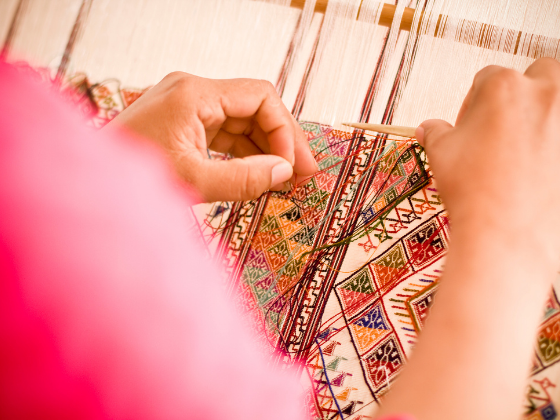
At the heart of Shehara is a close-knit team of women artisans working from a small home-based atelier in Colombo, Sri Lanka. From intricately crocheted raffia to sculptural leather and ribbon clutches, each piece reflects their skill, patience and attention to detail. In this interview, founder Shehara Dias shares the brand's beginnings, the women behind its creations and her vision for making traditional craftsmanship feel effortlessly modern.
Below, founder Shehara Dias takes us behind the brand, sharing her creative journey, the artisans behind each piece and her passion for Sri Lankan craftsmanship.
You’re originally from Sri Lanka and now based in Singapore. How did Shehara begin, and what was happening in your life when you decided to start the brand?
It was after COVID in 2022, and the Australian athleisure brand Lorna Jane that I had been working for ceased operations in Singapore and across Asia, like many other retail businesses at the time. Thereafter, I was contemplating starting my own fashion brand, when I was given the opportunity to choreograph a fashion show for the Sri Lankan embassy in Singapore. Therein I was fortunate enough to meet and work with a famous Sri Lankan Batik designer, Sonali Dharmawardena, who I eventually decided to collaborate with and launch my very first collection of handmade Batik Dresses, under the ‘Shehara’ brand.
Why did you choose to build the brand around crochet? What was your relationship with the craft before Shehara existed?
Shehara is not just crochet. It is a clothing and accessories brand, and crochet, for the most part, forms the basis of the hand bag collection. I wanted to incorporate Sri Lanka’s rich and diverse heritage craft industry, like Batik and Reed weaving, into the brand, and discovered Crochet as a niche craft technique for bags. It was an entirely new concept to me.
Your pieces are made in a home-based atelier of just six women in Colombo. How did you first meet and begin working with them?
My best friend in Colombo, Sri Lanka, introduced me to her relative who was running a small home based crochet business in Colombo, employing a group of women artisans from around the neighbourhood. This small atelier was eager and willing to accommodate my design ideas and bring it to fruition. Most of the designs I introduced to them they had never attempted before. Therefore I was able to challenge them from the onset, and push the boundaries in terms of what they could do.
Tell us about these women. Who are they, and what does each person bring to the atelier?
The women behind the atelier are really the heart of what we do. Each of them brings a different strength to the process, and together they make the atelier work as a very cohesive close-knit team.
Dinu is the creative force & design technician behind the atelier. She has developed crochet as a viable craft and home business, and personally trained and employed all the women artisans who work alongside her. She brings the creative vision, technical knowledge and attention to detail, while also guiding the team and making sure that every piece reflects the standard she has established.
Nilmini has a particularly good eye for quality. She is the person who checks the finished work and makes sure that the pieces meet the expected standard before they leave the atelier. She brings that important final level of care and quality control to the team.
Nirosha is incredibly neat, tidy and organised. Alongside her craftwork, she takes responsibility for keeping the stocks organised and ensuring that materials and finished pieces are properly maintained. She brings a sense of order and structure to the atelier, which is extremely valuable in the day-to-day running of the business.
Nayana is skilled in both sewing and crochet, which makes her very versatile. She can move between different parts of the production process and brings both technical ability and flexibility to the team.
Champa is particularly talented at hand sewing and crochet. Her strength is in the detailed, hands-on work that requires patience, precision and a very good understanding of the craft.
Every finished piece therefore carries something from all of them — Dinu’s creative vision, Nilmini’s eye for quality, Nirosha’s organisation, Nayana’s versatility, and Champa’s craftsmanship. The atelier is very much a collective effort, built around women developing a craft and contributing their own individual strengths to it.
Can you walk us through how one Shehara bag is made, from your first idea in Singapore to the time it takes to create the finished piece in Colombo?
An idea / design for a crochet clutch can come from a variety of mediums ie. Social media, travel inspiration, a personal bag I own etc. Thereafter the design is sketched out along with measurements and discussed with Dinu, the Design Technician, at the studio in Colombo. She will then make a proto type sample of the clutch to see if it is achievable. Once we have fine tuned the design and made all the adjustments, and are happy with the final desired outcome, we proceed with the bulk order. This entire process from initial conception to final approved product can take appx. 1-2 weeks depending on the complexity of the design.
You work with raffia, leather, ribbon and other materials. What determines which material is right for a particular design?
We choose materials based on what the design needs to be and what the design needs to do. Ie. the look vs the functionality. Some clutches need more structure, some need softness, some need texture or lightness etc Raffia, Ribbon and Leather all behave very differently from one another. Therefore we think about shape, weight, functionality, durability and how they all work together seamlessly to create the perfect clutch. The raw material has to ultimately support the design, rather than fight against it.
What is technically difficult about crocheting a structured handbag that someone unfamiliar with the craft might not realise?
One of the most technically challenging aspects of crocheting a bag is maintaining the structure and consistency of the design under consideration. Crochet is naturally flexible, so when making a structured handbag, one has to control the tension of the stitch very carefully throughout the entire process. Even a small change in tension can affect the size, shape or symmetry of the finished product.
The raw materials also behave differently depending on what we are working with. Raffia, Ribbon, Leather and other fibres can have different levels of stretch, stiffness and thickness, so the technique has to be adjusted accordingly.
There is also a lot of precision involved in shaping corners, keeping both sides symmetrical, creating clean edges and making sure handles, closures and other components sit in exactly the right position. With a structured bag, any small irregularity is much more visible.
Another challenge is creating enough firmness without losing the ‘handmade’ character of the clutch. Sometimes the raw material, and crochet stitch itself provides the structure we are hoping for, whilst other times we may require additional reinforcement techniques such as lining or carefully constructed internal elements.
What people often don’t realise is that you’re almost engineering the shape of the bag as you crochet it. A beautiful bag has to look effortless when it is finished, but achieving that consistency requires experience, patience and a very good understanding of both the craft and the raw material being used.
Please choose two pieces that Dia will be carrying and tell us the story behind each—where the idea came from, the materials and techniques involved, and what makes each special to you.
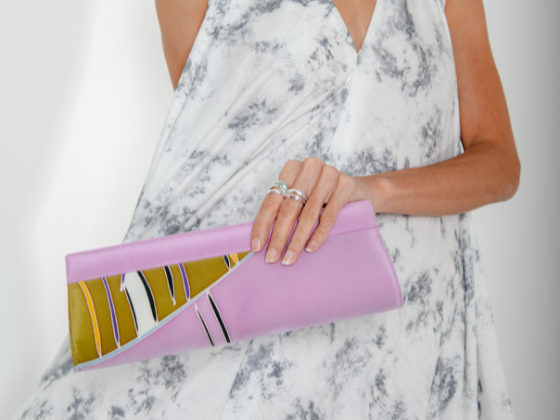
- Grosgrain Clutch
At the very start when I was researching raw materials that could potentially be utilized for crocheting of handbags, I came upon ribbon, and specifically Grosgrain Ribbon. I thought it was unique and not so widely used like Raffia is. So I decided to give it a go. I loved the texture and handfeel of Grosgrain Ribbon and how it made a clutch look and feel luxurious. Therefore, we crafted the Grosgrain clutch utilizing the Single Crochet stitch, which is a simple technique, keeping in mind the structured nature of the raw material being used. Hence, this clutch will always be special to me since it was the very first crochet clutch I introduced.
- Mini Leather Puff Clutch
The idea of crocheting with Leather came from Dinu my design technician. Having been challenged by me to push the boundaries in terms of raw materials and techniques, she suggested the use of synthetic leather yarn for our bags. It was a novel idea to both of us. Thereafter the Mini Leather Puff clutch was born using Nappa Pico Poly Leather yarn. And the technique I selected was the Puff stitch, which allowed for a chunky 3 dimensional texture to the clutch. I am extremely proud of how this clutch turned out, and since its introduction into the market, it has swiftly become our best seller and crowd favourite!
What has surprised you most about building Shehara so far?
What has surprised me most about building my own fashion brand, is how much more it is, than simply creating clothes and accessories. It is a journey of trusting my instincts, learning as I go, and seeing an idea that started in my head come to life through the hands of other people.
I've also been surprised by how much the little details matter — from choosing a colour and perfecting a silhouette, to the craftsmanship behind every hand-crocheted bag. Most of all, I've loved discovering that the pieces people connect with are often the ones that feel the most authentic to me.
And perhaps the biggest surprise of all - how personal it feels to build something that carries my name and my vision.
When someone encounters a Shehara piece for the first time, what do you hope they notice before anything else?
When someone encounters a Shehara piece for the first time, I hope they notice the effortlessness of it. I want each piece, be it clothing or handbags, to feel beautiful without being overly complicated - feminine, confident and timeless, with details that reveal themselves the more you look.
And most importantly, I hope they sense the craftsmanship and intention behind it.
Every Shehara piece is designed to feel special, and be something that you can truly cherish and make your own.
