
Kasama may have started with a bottle of rum, but Alexandra Dorda-Marcu always imagined a much bigger world around it. Inspired by her Philippine heritage and the particular joy she finds in bringing people together, she has since extended Kasama into colourful objects for the table, wardrobe, and a tropical getaway.
The Philippines supplies an endless visual vocabulary: oversized flowers and leaves, abundant fruit, layered colours, and the feeling of the outdoors finding its way inside. These references become mismatched embroidered coasters, a clutch decorated with a straw banana, and handwoven abacá bags blooming with dimensional flowers.
Made in partnership with small, female-founded businesses and artisans in the Philippines, the pieces share Alexandra’s light-hearted approach to design: conversation starters that don’t take themselves too seriously—and that might make gathering around a table a little more fun.
Below, the founder take us behind the brand.
Kasama began as a rum brand in 2021. When did you first realise that the world of Kasama could extend beyond what was inside the bottle?
Right from the very beginning. It was always clear to me that the Kasama brand was not about rum specifically, but about celebrating the beauty and joy of the tropics, inspired by my Philippine heritage. The brand has always been about gathering, celebration, and a laid-back tropical lifestyle, and that can be expressed through rum, fashion and home accessories, and so many other things.
What does the name “Kasama”, “togetherness” in Tagalog, mean to you personally, and has its meaning changed as the brand has grown?
Kasama is about celebrating gathering in all its many forms. I love the alchemy that happens when you bring people together into one space. At the beginning when Kasama was exclusively a rum brand, the focus was on gathering around a meal with a cocktail or beverage. For our lifestyle line, it is still about that, and some of our best sellers are our coasters, which help to dress up a table. But many of our pieces are conversation starters: our Go Bananas! Clutch, for example, is embroidered with a bunch of bananas. It’s a quirky and unexpected design, and I always get asked about it whenever I wear it. I love that a piece like that can spark connection.
When you think about the Philippines aesthetically, what colours, objects, places, textures, or scenes come immediately to mind?
I am so inspired by the aesthetic of the Philippines, which is such an fascinating melting pot of different cultures. The way Filipinos layer is so special, whether its textures, colours, or flavours in our food.
In the Philippines, plants are a large part of the design vernacular. Oversized flowers and leaves are often used as décor, and there is this sense of the outdoors coming in, which I love. These can be real life plants, but it’s often expressed through oversized murals, or as flowers and plants on clothing. I’ve always been drawn to plants, which is why flowers, leaves, and fruits feature so prominently in our collection, especially on our Paradiso and Tropicana bags, which feature oversized 3D flowers that give the pieces a lot of dimension.
What have you learned from your mother about Filipino culture—or simply about how to live—that has found its way into Kasama?
My mother has taught me so much! She is a successful entrepreneur who ran her own business for over 20 years. She is also the most resourceful person I know and has taught me so much about creativity and grit. She also used to be a buyer at Bullocks Wilshire (a now shuttered luxury department store in Los Angeles), so she is always giving me advice on my inventory, assortment, and how much to buy and when. And of course, she has instilled in me a deep love of Philippine culture which is the inspiration behind Kasama.
Can you walk us through how a Kasama piece comes together, from the initial idea to the finished object?
This is my favorite part of running Kasama. Everything I create starts from a tiny spark of an idea, and these usually just drop into my head. Often these ideas are not fully formed yet, so I’ll ruminate on them until I have a full concept that resonates with me. From there, I love pulling on a hundred different threads to bring that thing to life, whether it is seeking out creative partners to help me design the piece, or production partners who can make it. I love scouring the internet to find the people that I need to bring something to fruition, and then iterating until it is just right. To me, there are few things more satisfying that going from concept to creation.
Please choose two or three pieces that Dia will be carrying and tell us the story, or what you find special, about each.- Three Kasama pieces and the stories behind them:
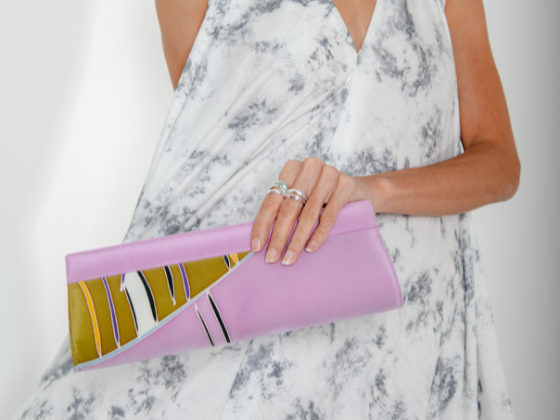
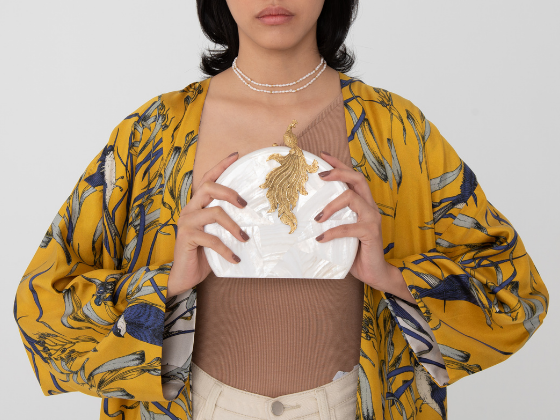
- Go Bananas! Clutch: I love bananas as a design element, and I designed this clutch to accompany me to many tropical getaways and summer weddings. The piece is handmade by team of artisans, who handmake each piece, including embroidering the banana in straw and finishing it with wooden beads for texture. It’s a quirky piece that doesn’t take itself too seriously.
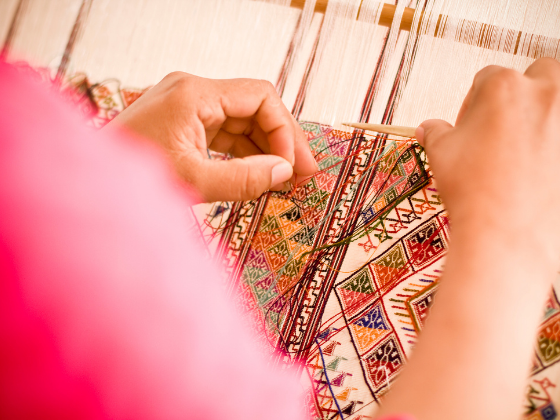
- Paradiso Bag in Noon: This is my favorite bag to carry to lunch or dinner at the beach. The pink, orange, and yellow 3D flowers give this bag wonderful dimension and vitality. Each bag is handwoven by artisans from abacá fiber, natural banana-leaf fiber that is that has been used in the Philippines for hundreds of years.
- Flores Coasters: This is Kasama’s best-selling item, which is so funny to me because when I first designed them, I thought they were unlikely to sell. I liked the idea that each coaster in the set features a different tropical flower (including the Rafflesia, which is the largest flower in the world and native to the Philippines). Coasters are typically designed to match, so I wasn’t sure if the mis-matched design would resonate with others. We’ve now sold thousands of sets, which must mean that the mis-matched design resonates with others as well!
How did you find the female-owned businesses and artisans you work with in the Philippines?
I found several of them at pop-ups in Manila. Many of the malls in Manila do a great job of supporting local artisans by regularly hosting pop-ups for small brands. I also found a few on Instagram, through trade shows, or through my network. I’m proud to say that all of our Philippine suppliers are small, female-founded businesses, just like Kasama.
Is there anything about Filipino design, craftsmanship, or culture that you think people outside the Philippines often overlook or misunderstand?
In my experience, Filipino design and culture is overlooked in general. One of the reasons that I started Kasama is because my mom and I are always floored by the talented designers, artisans, and creators we encounter in the Philippines, and we find that they don’t get enough airtime outside of the country. I hope that my brands are playing a small part in changing that. I believe that one day, the Philippines will be rightfully recognised as a global hub for design.
When someone encounters Kasama for the first time, how do you want them to feel?
I hope that our collection makes them smile. I like to say that the sun is always shining in the world of Kasama. Our pieces are colourful, quirky, and don’t take themselves too seriously, so I hope they bring some tropical sunshine with them wherever they go.
In the course of building this brand, what have you found most challenging, and what have you found most fulfilling?
The most fulfilling part for me is always the process of bringing things to life, whether that’s a new brand, or individual products, and getting to work in partnership with other people whose work inspires me. The most challenging part is trying to scale a brand with a very limited budget when so many other brands spend millions on content or digital advertising.
This interview has been edited for brevity and clarity.