

Byline: By Aisha Hassan on December 9, 2025
On a sunny day in Singapore, I encountered my first LesKoy scarf. The brand’s Creative Director, Muni, had reached out to put her creations on Dia, and what I discovered in person that day, and later again in Kuala Lumpur when the full collection arrived and Muni shared her story, was a luxury product so steeped in meaning and craft that Dia truly felt like its rightful home.
LesKoy is a study in heritage reframed: silk scarves that translate the rhythm, color, and storytelling of the Swahili Coast into a modern, finely crafted language. Muni merges the electric hues of her Kenyan upbringing with memories of her grandmother, and pairs the vibrancy of East Africa with artisanal techniques from Cambodia and Indonesia. The result is a handwoven silk scarf shaped through a meticulous, multi-stage artwork and silkscreen process, anchored by original illustrations and colour combinations that feel at once contemporary and ancestral.
We are proud to share this wearable art at Dia. Below, Muni tells us more in her own words.
How does your heritage shape the way you see color, pattern, and adornment today?
I grew up in Kenya and my formative years were spent steeped in the electric energy of Africa. My world bursting with rich and vibrant colors, intricate patterns, and the art of adornment: tactile beauty of layered jewelry and henna art. These early years built the foundations for my artistic sense, and calibrated the sensory language that I use in my work today. LesKoy is a celebration of the beauty of my birthland and my afro-arab heritage.
The name LesKoy merges the Leso and Kikoy. What does that fusion, and the name, represent to you personally?
The leso and kikoy are two ubiquitous fabrics found on the Swahili Coast. The Leso's lineage traces back to the Portuguese lenços, which became a vibrant canvas for East African women to stitch six scarves into one, a tribute honored by our Asli Miswani Collection. Later, an Indian trader introduced the single block-printed cloth used today. The kikoy is a woven piece of fabric that has stripes along its borders. Favoured by men, worn as a sarong at leisure, it is the ultimate loungewear. LesKoy takes the fabrics from my youth and weaves them into the contemporary, fashionable language of today. For me, the fusion embodies the male and female; the ying and yang; the austere and opulent; restrained and flamboyant. The clash of opposites. No matter your style, you can express yourself with a LesKoy scarf.
What early memory of seeing or wearing a leso has stayed with you most?
The leso is a memory keeper. One moment is etched in my mind: sitting at a relative's house in Kibokoni when a friend of my bibi (grandmother) gave bibi a gift of a leso. Instead of just admiring it, she engaged us, her grandkids, asking us to share the story the cloth told, a story she validated with a knowing smile and a nod. This memory resurfaced years later in college when my fabrics teacher, Manuel Aja-Herera, steered me toward silk-screen printing with leso patterns. That simple, shared storytelling is the genesis of my fascination. I connected deeply to all the stories when I was living in Asia, encountering Batiks, Ikats and Songkets. Each fabric had a story and place in society. And I wanted to infuse what I had encountered in Asia woven with the fabric of my youth.
What story does your signature green, coral, and copper color palette tell?
Our palette is a silent tribute. Green is the foundation, a color my late bibi adored, and in whose memory the brand was founded—her favorite became our creative north star. I chose coral to ignite a feminine contrast against the rich green, loving its beautiful juxtaposition of earth and sea; it’s a living color also honored in scriptures. The final note, copper, offers an incandescent warmth that binds the two, giving the palette its signature, resonant identity.
You’ve said your logo—the guinea fowl—symbolizes “wearing what cannot be spoken.” What emotions or narratives do you hope your scarves express for their wearers?
The guinea fowl—khanga—is the vibrant namesake of the cloth in Tanzania and Comoros Island, a famously flamboyant bird unafraid to show off. This symbol is profound in Swahili culture, where open confrontation is rare, and emotions are instead woven into song, methalis (idioms), and fabric. Our logo embodies this tradition: wearing what cannot be spoken. We design our scarves to be a personal armor and an eloquent expression—a wearable story that either evokes a treasured memory or allows the wearer to communicate their inner narrative without uttering a single word.
Tell me about your silk twill and why you chose it for a garment traditionally made of cotton?
Growing up, the cotton leso's inherent limitations felt like a creative constraint—while I adored their vibrant color and pattern, their drape was heavy, confining them to the world of casual loungewear. To transcend this, we sought a fabric that could carry the soul of the leso into the modern era, and silk twill emerged as the ultimate canvas.
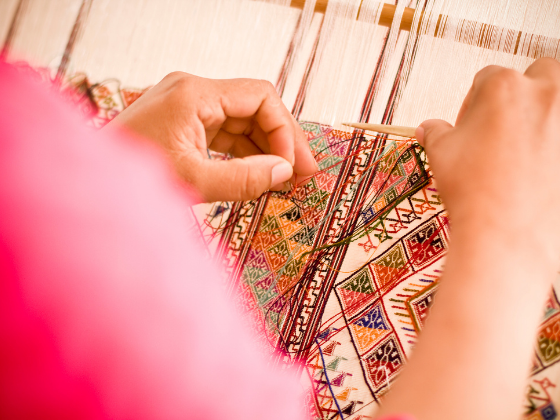
It offers superior durability and requires minimal maintenance, yet, most crucially, it is exquisitely pliable, allowing it to drape and mold to the wearer's body in a way cotton simply cannot. The creation of this modern canvas is a true labor of love, beginning with a long, intricate, multi-step hand-weaving process: our scarves are meticulously woven with an incredibly fine, light yarn by a talented team of women in Cambodia. This dedication and artistry ensures a delicate, sheer quality and an exquisite feel. Furthermore, the advantage of silk lies in its unmatched color absorption, allowing the vibrancy of our designs to be truly incandescent and unparalleled.
Take me through the process of creating the prints you illustrate yourself.
The process begins with a deep dive—a layered, intellectual research into a topic that has utterly piqued my interest, exploring every facet and angle. As a fashion and graphic designer by trade, my quest is to find a clear visual communication solution. I masticate on the problem while preliminary sketches begin to take form. Only the strongest concepts graduate to the tangible world of pen and paper. I then bring the hand-drawn artwork into the digital realm, scanning and manipulating it in programs like Illustrator to refine the line work, add intricate details, and finally, bring the color story to life.
Can you walk us through the silkscreen process for one LesKoy scarf? What are the parts most people don’t see or appreciate?
The true soul of the LesKoy scarf lies in what you don't see: the patient, labor-intensive devotion required to awaken the design. Weaving alone has seven stages, and the silk-screen printing is another meticulous eight-step journey. The most critical, least-appreciated phase is the prep work: translating the design into plotter-friendly art and then the demanding process of exposing the artwork onto the frames, where six or more layers of print must align with micro-precision. The final color palette is a carefully choreographed dance, tested first on cotton, then on silk, before finally meeting the Koy fabric. This entire process—from frame fabrication to plotting, exposure, meticulous washing, and three rounds of color testing—is highly prone to error due to the multiple layers and can take anywhere from one to three weeks.
It is a slow, deeply manual process, but the moment the colors align and the design breathes life onto the fabric, the effort is instantly justified. Because the scarves are first hand woven to size, we encounter additional restraints that traditional silk scarves do not. However, this is what ensures that each scarf will be unique to the wearer, as the margins can change slightly from one piece to the next. While this presents an additional challenge, it is a rare opportunity to make each LesKoy truly one-of-a-kind.
What part of the LesKoy creation process brings you the most joy?
The deepest joy arrives in the moment of coalescence—when the dreaming, the creative problem-solving, and the tireless execution all fall into perfect alignment, bringing the artwork to life. The ultimate, most profound reward, however, is the echo we hear from our customers and fans: that the scarf has become a source of joy or a cherished keeper of happy memories for them.
What’s inspiring you lately?
My wellspring of creativity is eternally, nature. Beyond its constancy, I travel to learn and unlearn my preconceived notions, a vital process that continually expands my artistic soul. I also find boundless joy in the rhythmic textures of music across a wide spectrum of genres. But perhaps the most evocative inspiration is color—the way a single hue can instantly shift a mood, speak the wearer's emotions, and act as a powerful, instant memory-maker, transporting me back to a specific time or event.
What does “luxury” mean to you—beyond materials and craftsmanship?
In our fast-paced, hyper-efficient world, time is the ultimate, true luxury. For LesKoy, luxury is the time we deliberately invest: the time it takes to meticulously design, the time to patiently bring a concept to life, and the time we spend cultivating meaningful partnerships with collaborators who share our unwavering passion for delivering the absolute finest.